Overview
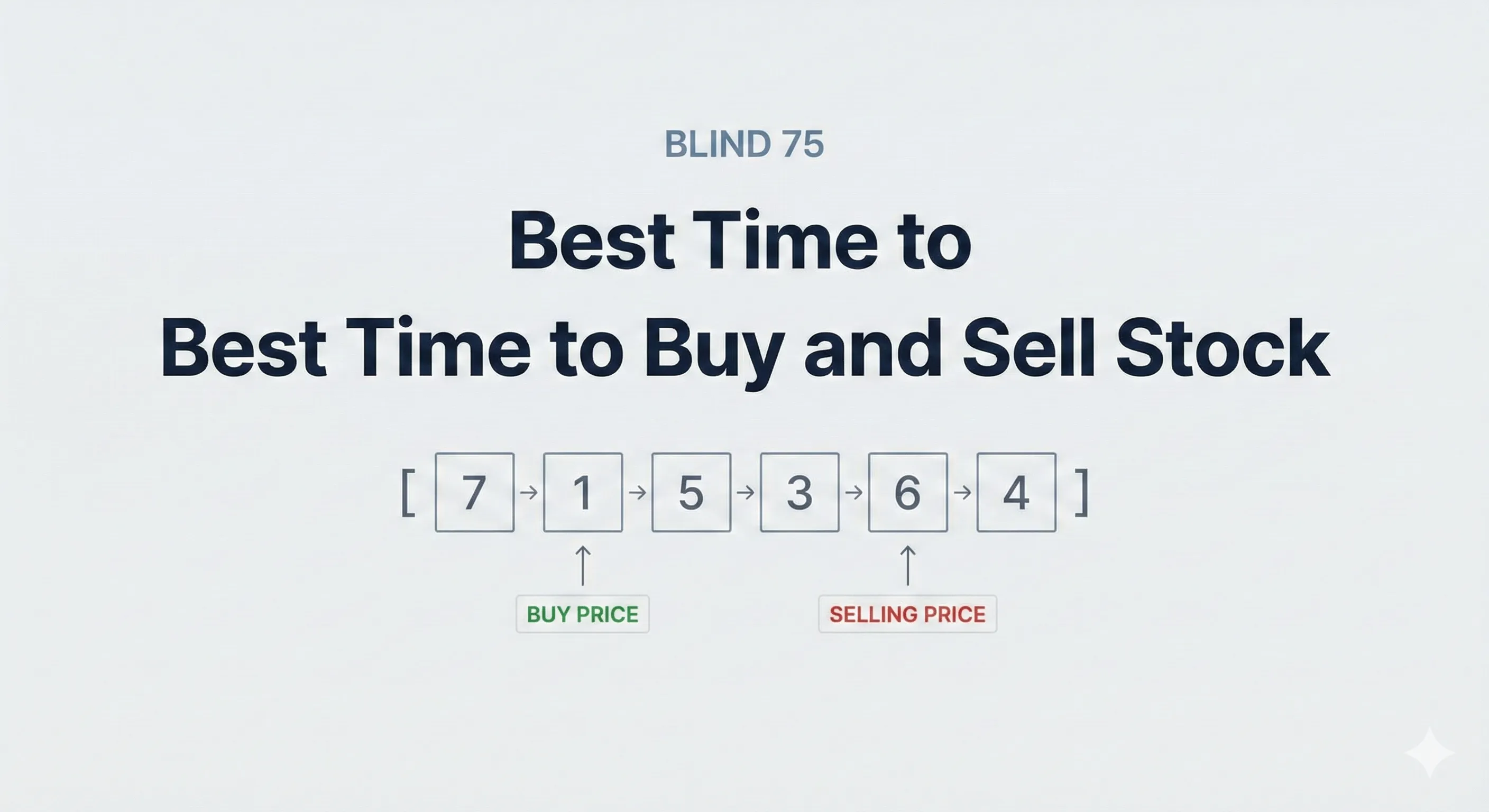
You’re given a list of stock prices where each index represents a day. You are allowed only one transaction:
- Buy on one day
- Sell on a future day
Your goal is simple: maximize profit.
If no profit is possible, return 0.
Problem Constraints
1 <= prices.length <= 10^5- Expected time complexity: O(n)
- Only one buy and one sell
- Sell must happen after buy
How I Approached the Problem
I follow a strict rule when solving problems like this:
- Make it work
- Then make it fast
So I deliberately explored multiple approaches—even incorrect ones—to understand what doesn’t work and why.
Brute Force Approach
The most straightforward idea:
- Try every possible buy day
- Try every possible sell day after it
- Track the maximum profit
Code
class Solution {
public:
    int maxProfit(vector<int>& prices) {
        int profit = 0;
        int n = prices.size();

        for (int buy = 0; buy < n; buy++) {
            for (int sell = buy + 1; sell < n; sell++) {
                profit = max(profit, prices[sell] - prices[buy]);
            }
        }

        return profit;
    }
};
Complexity
- Time: O(n²)
- Space: O(1)
Why This Fails
With n up to 10^5, this approach performs billions of comparisons.
It works logically—but fails practically due to TLE.
Failed Attempts (and Why They Matter)
Before landing on the optimal solution, I tried a couple of “clever” ideas. They didn’t work—but they taught me why the correct solution does.
Attempt 1: Two Pointer Approach
Idea:
- Buy pointer at the start
- Sell pointer at the end
- Move pointers based on price comparison
class Solution {
public:
    int maxProfit(vector<int>& prices) {
        int n = prices.size();
        int i = 0, j = n - 1;
        int profit = INT_MIN;

        while (i < j) {
            profit = max(profit, prices[j] - prices[i]);

            if (prices[i] > prices[j]) i++;
            else j--;
        }

        return max(profit, 0);
    }
};
Why It Fails
- Prices are not sorted
- Valid buy–sell pairs are skipped
- Pointer movement is based on assumptions that don’t hold
This approach looks elegant but breaks under real input.
Attempt 2: Sell at Maximum Price
Idea:
- Find the highest price in the array
- Buy at the lowest price before it
class Solution {
public:
    int maxProfit(vector<int>& prices) {
        int n = prices.size();
        if (n <= 1) return 0;

        int maxSell = INT_MIN;
        int maxSellIndex = 0;

        for (int i = n - 1; i >= 0; i--) {
            if (prices[i] > maxSell) {
                maxSell = prices[i];
                maxSellIndex = i;
            }
        }

        int profit = 0;
        for (int i = 0; i < maxSellIndex; i++) {
            profit = max(profit, maxSell - prices[i]);
        }

        return profit;
    }
};
Why It Fails
- Selling at the highest price doesn’t always give max profit
- The optimal buy–sell pair may happen earlier or later
Optimal Solution — One Pass
The Key Insight
You don’t need to know the future.
You only need two things:
- The minimum price so far
- The best profit so far
At each day:
- Assume you sell today
- Check if today’s price minus the lowest past price improves profit
Code
class Solution {
public:
    int maxProfit(vector<int>& prices) {
        int buy = prices[0];
        int profit = 0;

        for (int i = 0; i < prices.size(); i++) {
            buy = min(buy, prices[i]);
            profit = max(profit, prices[i] - buy);
        }

        return profit;
    }
};
Complexity
- Time: O(n)
- Space: O(1)
Why This Works
- Buying always happens before selling
- The lowest price is tracked dynamically
- Each element is processed exactly once
- No unnecessary comparisons or assumptions
This is optimal in both theory and practice.
Final Takeaways
- Don’t jump straight to optimization
- Failed approaches clarify constraints better than successful ones
If you can explain why your failed solution failed, you understand the problem.
That’s the real win.