Problem Overview
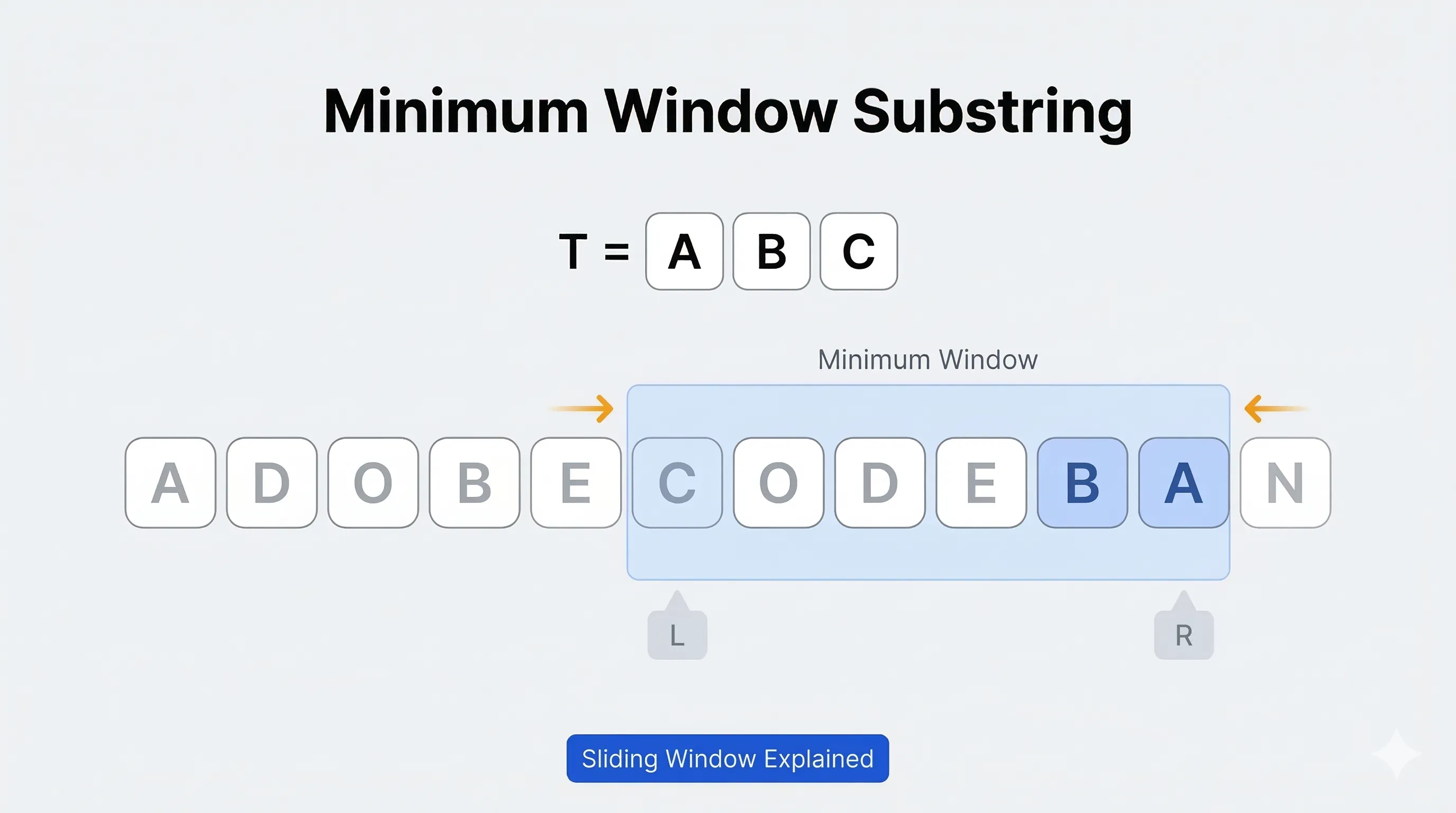
Given strings s and t of length m and n respectively, return the minimum length substring of s such that every character in t is present in the substring. The substring can contain duplicate characters.
Example:
Input:  s = "ADOBECODEBANC", t = "ABC"
Output: "BANC"

BANC is the minimum window containing all characters from t.
Brute Force
Intuition
- Store each character’s frequency from
tin a map - Use two nested loops to iterate over all substrings
- Track character frequencies and a
countof matched characters - When
count == t.size(), compare against the current best answer
Code
class Solution {
public:
    string minWindow(string s, string t) {
        unordered_map<char,int> mp;
        for (char c : t) mp[c]++;

        string ans = "";
        int minLen = INT_MAX;
        int m = s.size(), n = t.size();

        for (int i = 0; i < m; i++) {
            int count = 0;
            unordered_map<char,int> temp;

            for (int j = i; j < m; j++) {
                if (mp.count(s[j]) == 0) continue;

                temp[s[j]]++;
                if (temp[s[j]] <= mp[s[j]])
                    count++;

                if (count == n) {
                    int len = j - i + 1;
                    if (len < minLen) {
                        ans = s.substr(i, len);
                        minLen = len;
                    }
                }
            }
        }

        return ans;
    }
};
Complexity
Time - O(m²) Space - O(m + n)
This gives TLE when s and t are large. We need an O(m + n) solution.
Also the subtr take k time.
Optimal Approach — Sliding Window
Intuition
- Expand the right pointer until the window contains all characters of
t - Then shrink from the left while all characters of
tare still present - Track the best valid window using
startandminLeninstead of extracting the substring on every update
Code
class Solution {
public:
    string minWindow(string s, string t) {
        unordered_map<char, int> mp;
        for (char c : t) mp[c]++;

        int n = t.size(), m = s.size();
        int i = 0, j = 0, count = 0;
        int minLen = INT_MAX, start = 0;
        unordered_map<char, int> temp;

        while (j < m) {
            if (mp.count(s[j])) {
                temp[s[j]]++;
                if (temp[s[j]] <= mp[s[j]])
                    count++;
            }
            j++;

            while (count == n) {
                int len = j - i;
                if (len < minLen) {
                    minLen = len;
                    start = i;
                }

                if (mp.count(s[i])) {
                    temp[s[i]]--;
                    if (temp[s[i]] < mp[s[i]])
                        count--;
                }
                i++;
            }
        }

        return minLen == INT_MAX ? "" : s.substr(start, minLen);
    }
};
Complexity
Time - O(m + n) Space - O(m + n)
What I Got Wrong Earlier
Instead of storing start and minLen, I was computing and storing the substring on every valid window:
if (len < minLen) {
    ans = s.substr(i, len);  //  substring extraction inside the loop
    minLen = len;
}
s.substr() is O(len) and calling it repeatedly caused TLE.
Instead of this we store the starting index of substring and compute the substring once at the end.
Key Takeaways
- Minimize unnecessary computation inside hot loops — defer
substrextraction to the end - Sliding window problems follow an almost identical pattern: expand right, shrink left, track the best state