Problem Overview
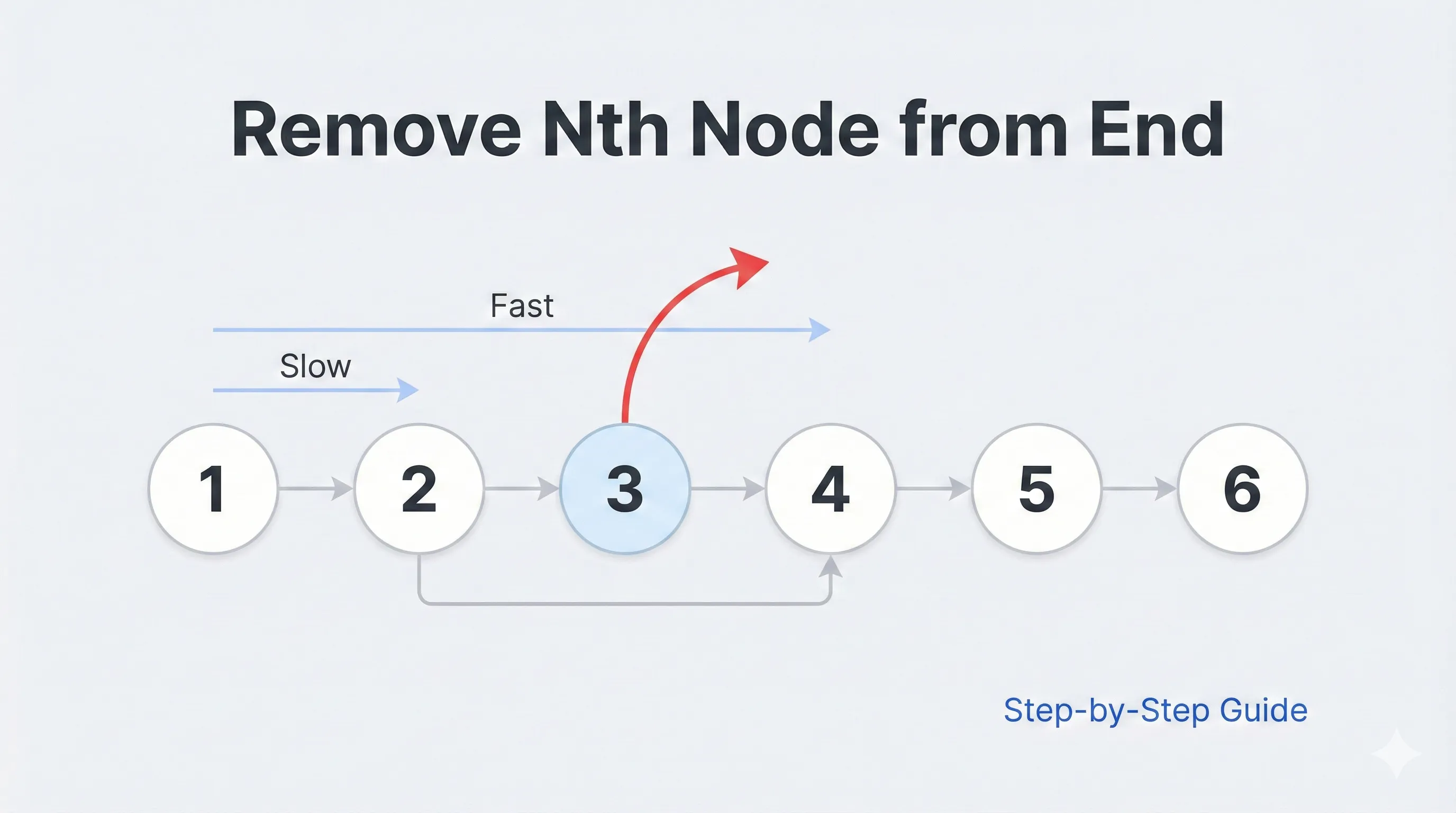
We are given the head of a singly linked list. We are given a node index n from the end.
The goal is to remove the nth node from the end of the list.
Constraints
- We have to do this in a single pass.
Brute Force Approach
Intuition
- We use a vector to keep track of the nodes and their indices.
- Once the traversal is finished, we calculate the node index from the start.
- Once we get that index, we remove that node.
Code
class Solution {
public:
    ListNode* removeNthFromEnd(ListNode* head, int n) {

        vector<ListNode*> arr;
        ListNode* curr = head;

        while (curr) {
            arr.push_back(curr);
            curr = curr->next;
        }

        int nodeFromStart = arr.size() - n;

        if (nodeFromStart == 0)
            return head->next;

        if (nodeFromStart < arr.size())
            arr[nodeFromStart - 1]->next = arr[nodeFromStart]->next;

        return head;
    }
};
Why This Fails
- It usegs extra space O(n).
- The problem requires a constant space solution.
Time and Space Complexity
- Time: O(n)
- Space: O(n)
Optimal Approach
We maintain two pointers similar to Floyd’s Tortoise and Hare technique.
- The fast pointer moves n + 1 steps ahead.
- Then both fast and slow move together.
- This maintains a constant gap of n between them.
- When fast reaches
NULL, slow will be just before the node to remove.
Edge Cases
- Introduce a dummy node before the linked list.
- If we have to remove the head, this makes handling easier.
- Without a dummy node, removing the head becomes tricky.
Code
class Solution {
public:
    ListNode* removeNthFromEnd(ListNode* head, int n) {

        ListNode* dummy = new ListNode(0);
        dummy->next = head;

        ListNode* fast = dummy;
        ListNode* slow = dummy;

        for (int i = 0; i <= n; i++) {
            fast = fast->next;
        }

        while (fast) {
            fast = fast->next;
            slow = slow->next;
        }

        slow->next = slow->next->next;

        return dummy->next;
    }
};
Time and Space Complexity
- Time: O(n)
- Space: O(1)
Key Takeaways
- Adding a dummy node before the linked list helps simplify edge cases.
- Maintaining a fixed gap between two pointers is a powerful technique.
- Two-pointer gap method is very common in single-pass linked list problems.
- Always think about edge cases like removing the head.