Problem Overview
- We are given a 2D matrix of size
n * n. - The matrix represents an image.
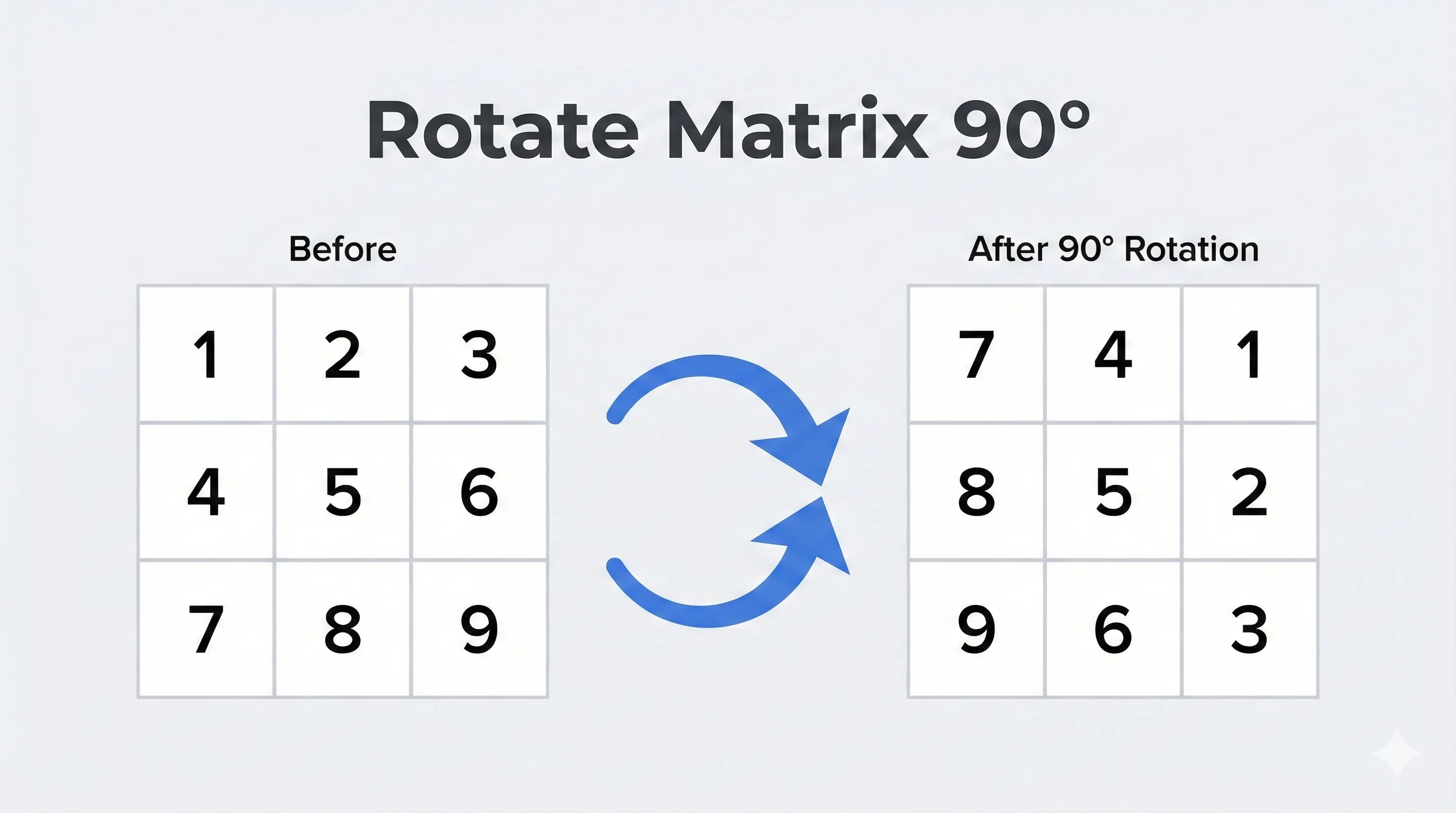
- Our goal is to rotate the image by 90 degrees clockwise.
- The solution must use constant extra space (in-place).
Example
Input:
matrix = [[1,2,3],
          [4,5,6],
          [7,8,9]]

Output:
[[7,4,1],
 [8,5,2],
 [9,6,3]]
Intuition
If we remember basic matrix properties:
- Transpose of a matrix
- Reverse of each row
If we:
- First take the transpose (swap
(i,j)with(j,i)) - Then reverse every row
We effectively rotate the matrix 90° clockwise.
Why this works:
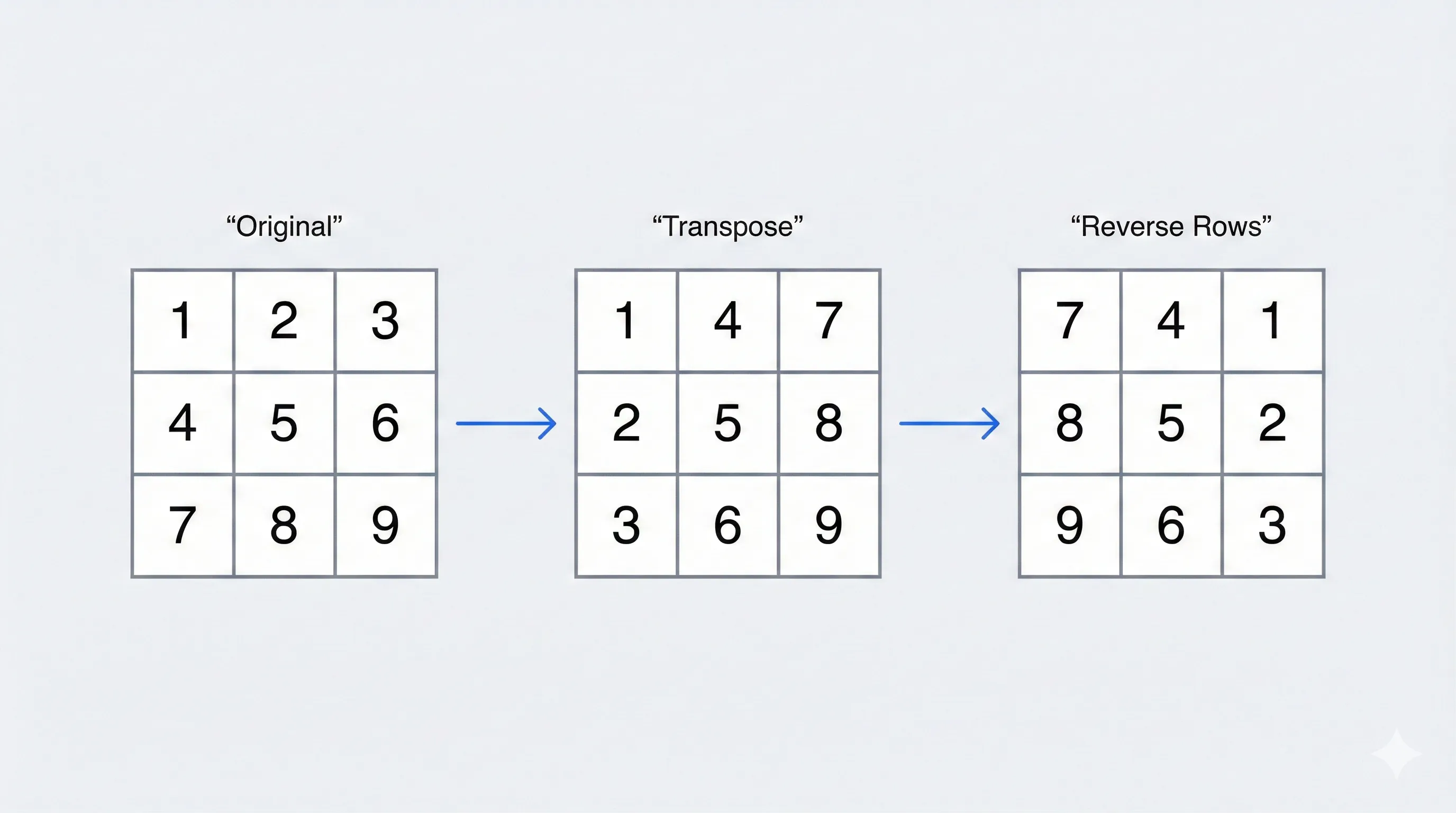
This is exactly a 90° clockwise rotation.
Approach
Step 1 — Transpose the Matrix
Swap:
matrix[i][j] ↔ matrix[j][i]
Important:
- Start
jfromi. - Otherwise you will swap elements twice.
Step 2 — Reverse Each Row
- Reverse only half of each row.
Edge Case:
- If we reverse the entire row twice, we get the original matrix.
- So only iterate till
n/2.
Optimal Solution
Code — Two Pointer Approach
class Solution {
public:
    void rotate(vector<vector<int>>& matrix) {

        int n = matrix.size();

        // Step 1: Transpose
        for (int i = 0; i < n; i++) {
            for (int j = i; j < n; j++) {
                swap(matrix[i][j], matrix[j][i]);
            }
        }

        // Step 2: Reverse each row
        for (int i = 0; i < n; i++) {

            int l = 0, r = n - 1;

            while (l < r) {
                swap(matrix[i][l], matrix[i][r]);
                l++;
                r--;
            }
        }
    }
};
Code — Using Nested Loops
class Solution {
public:
    void rotate(vector<vector<int>>& matrix) {

        int n = matrix.size();

        // Transpose
        for (int i = 0; i < n; i++) {
            for (int j = i; j < n; j++) {
                swap(matrix[i][j], matrix[j][i]);
            }
        }

        // Reverse each row
        for (int i = 0; i < n; i++) {
            for (int j = 0; j < n / 2; j++) {
                swap(matrix[i][j], matrix[i][n - 1 - j]);
            }
        }
    }
};
Time & Space Complexity
Time: O(n²)
- Transpose → O(n²)
- Reverse → O(n²)
Space: O(1)
Final Takeaway
- Knowing matrix properties (like transpose) simplifies problems.
- Many in-place matrix transformations are combinations of smaller operations.