Problem Overview
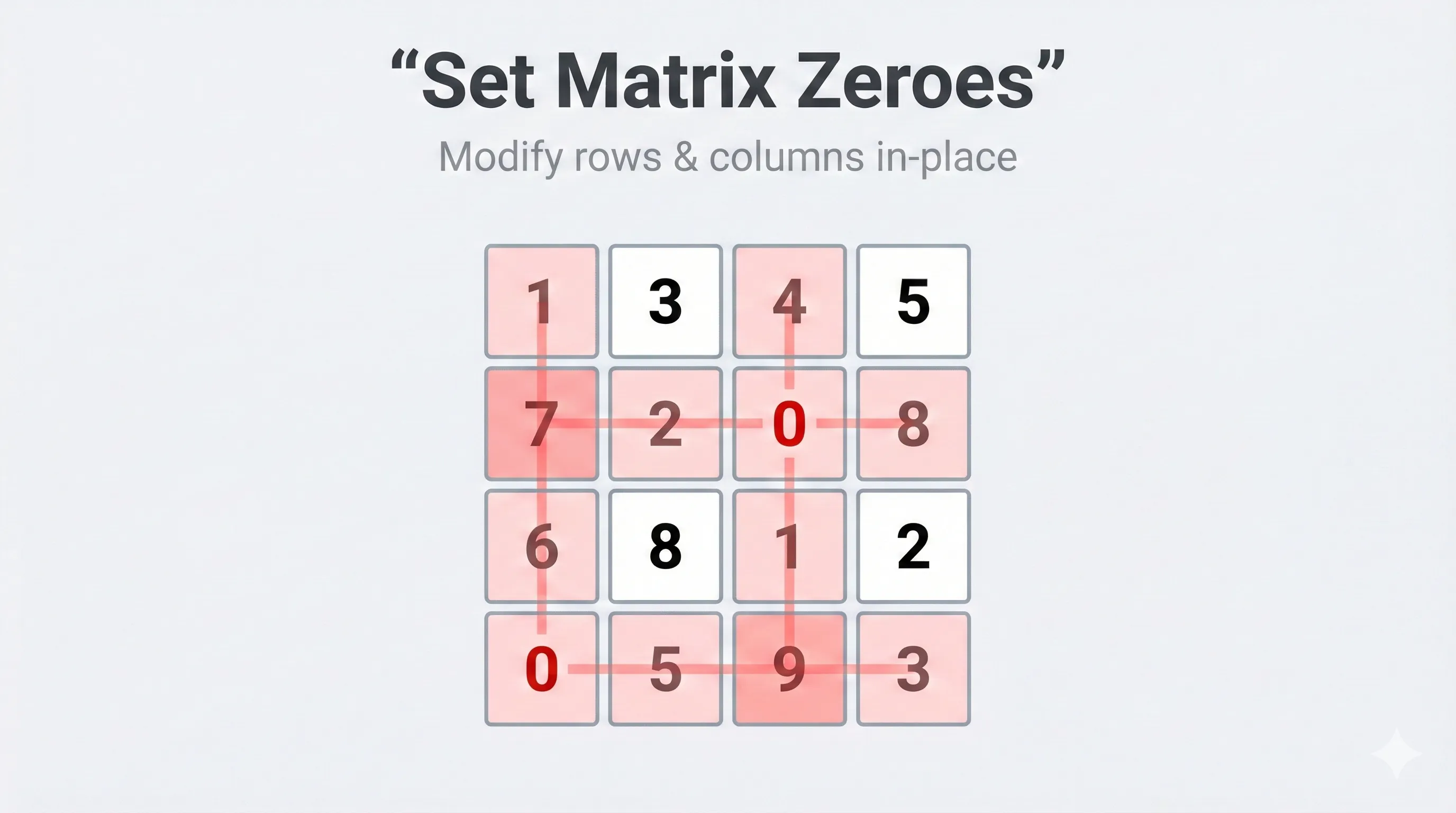
- We are given a matrix of size
m * n. - If any element in the matrix is
0, set its entire row and column to0. - Constraint:
- The solution must use O(1) extra space.
Example
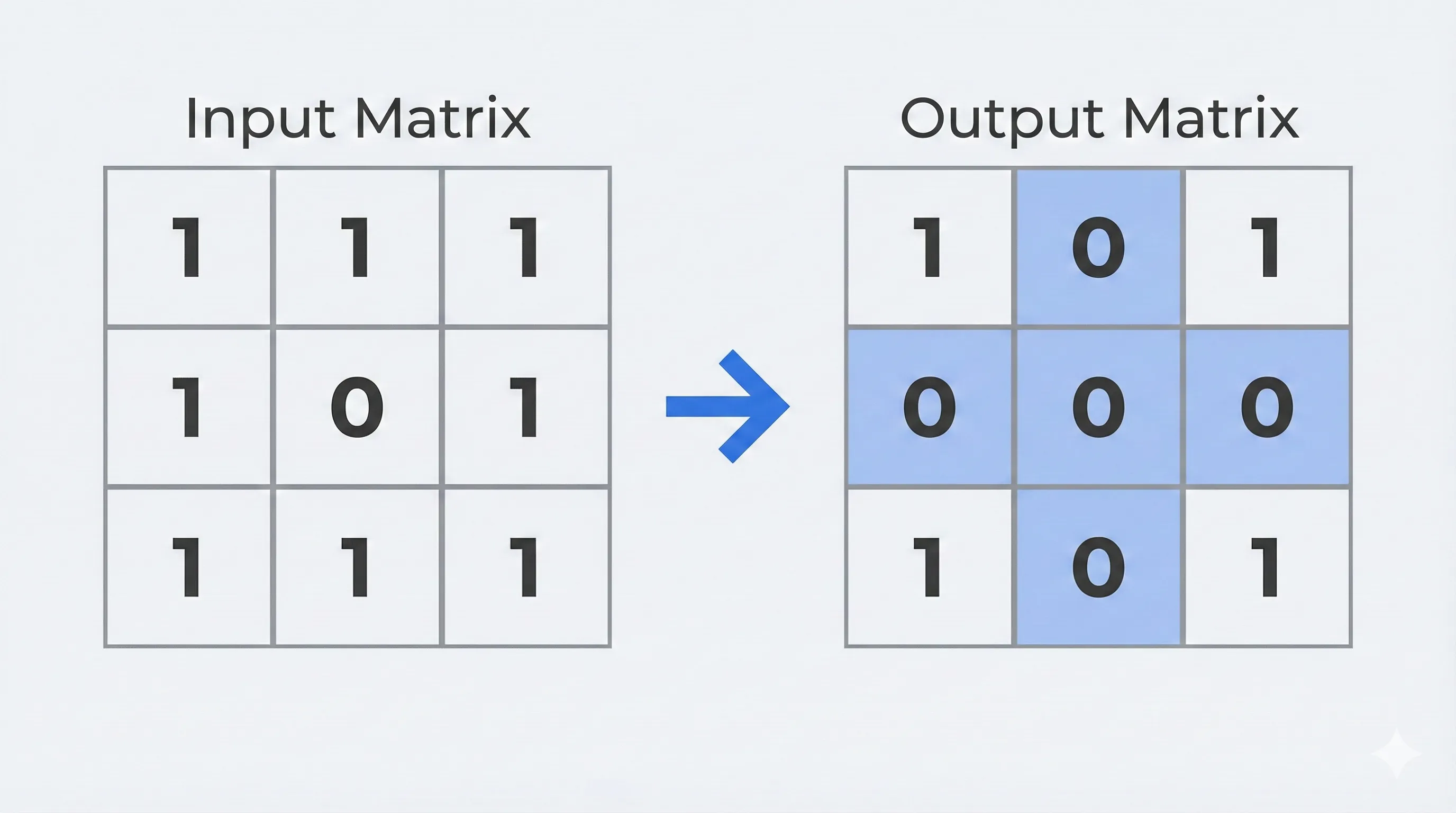
Input: matrix = [[1,1,1],[1,0,1],[1,1,1]]
Output: [[1,0,1],[0,0,0],[1,0,1]]
Brute Force
Intuition and Approach
Use an
unordered_mapto store positions of original zeros.In a second traversal:
- If a cell was originally zero, set its entire row and column to zero.
class Solution {
public:
  void setZeroes(vector<vector<int>>& matrix) {

      int m = matrix.size();
      int n = matrix[0].size();

      bool firstRowZero = false;
      bool firstColZero = false;

      // Check first row
      for (int j = 0; j < n; j++) {
          if (matrix[0][j] == 0)
              firstRowZero = true;
      }

      // Check first column
      for (int i = 0; i < m; i++) {
          if (matrix[i][0] == 0)
              firstColZero = true;
      }

      // Mark rows and columns
      for (int i = 1; i < m; i++) {
          for (int j = 1; j < n; j++) {

              if (matrix[i][j] == 0) {
                  matrix[0][j] = 0;
                  matrix[i][0] = 0;
              }
          }
      }

      // Set rows to zero
      for (int i = 1; i < m; i++) {
          if (matrix[i][0] == 0) {
              for (int j = 1; j < n; j++) {
                  matrix[i][j] = 0;
              }
          }
      }

      // Set columns to zero
      for (int j = 1; j < n; j++) {
          if (matrix[0][j] == 0) {
              for (int i = 1; i < m; i++) {
                  matrix[i][j] = 0;
              }
          }
      }

      // Handle first row if first row contains zero
      if (firstRowZero) {
          for (int j = 0; j < n; j++) {
              matrix[0][j] = 0;
          }
      }

      // Handle first column if first column contains zero
      if (firstColZero) {
          for (int i = 0; i < m; i++) {
              matrix[i][0] = 0;
          }
      }
  }
};
Why It Fails
- Extra space used is proportional to the number of zeros.
- In the worst case, we store almost
m * npositions using O(m*n) space.
Time and Space Complexity
- Time: O(m * n)
- Space: O(m * n)
In-Place Optimal Solution
The trick is to use the first row and first column as markers instead of extra space.
Intuition and Approach
Check if the first row contains zero.
Check if the first column contains zero.
Traverse the matrix from
(1,1)to(m-1,n-1):- If
matrix[i][j] == 0- Mark
matrix[0][j] = 0 - Mark
matrix[i][0] = 0
- Mark
- If
Traverse rows again:
- If first element of row is zero, set the entire row to zero.
Traverse columns again:
- If first element of column is zero, set the entire column to zero.
Finally, handle the first row and first column separately.
Edge Case
- First row and first column are used as markers.
- If they originally contained zero, we must remember that using two boolean flags else we loose that data in the process.
Code Implementation
class Solution {
public:
    void setZeroes(vector<vector<int>>& matrix) {

        int m = matrix.size();
        int n = matrix[0].size();

        bool firstRowZero = false;
        bool firstColZero = false;

        // Check first row
        for (int j = 0; j < n; j++) {
            if (matrix[0][j] == 0)
                firstRowZero = true;
        }

        // Check first column
        for (int i = 0; i < m; i++) {
            if (matrix[i][0] == 0)
                firstColZero = true;
        }

        // Mark rows and columns
        for (int i = 1; i < m; i++) {
            for (int j = 1; j < n; j++) {
                if (matrix[i][j] == 0) {
                    matrix[0][j] = 0;
                    matrix[i][0] = 0;
                }
            }
        }

        // Set rows to zero
        for (int i = 1; i < m; i++) {
            if (matrix[i][0] == 0) {
                for (int j = 1; j < n; j++) {
                    matrix[i][j] = 0;
                }
            }
        }

        // Set columns to zero
        for (int j = 1; j < n; j++) {
            if (matrix[0][j] == 0) {
                for (int i = 1; i < m; i++) {
                    matrix[i][j] = 0;
                }
            }
        }

        // Handle first row if needed
        if (firstRowZero) {
            for (int j = 0; j < n; j++) {
                matrix[0][j] = 0;
            }
        }

        // Handle first column if needed
        if (firstColZero) {
            for (int i = 0; i < m; i++) {
                matrix[i][0] = 0;
            }
        }
    }
};
Time and Space Complexity
- Time: O(m * n)
- Space: O(1)
Final Takeaways
- The first row and first column can act as storage.
- Edge cases matter — especially when the storage area itself contains 0 data.