Problem Overview#
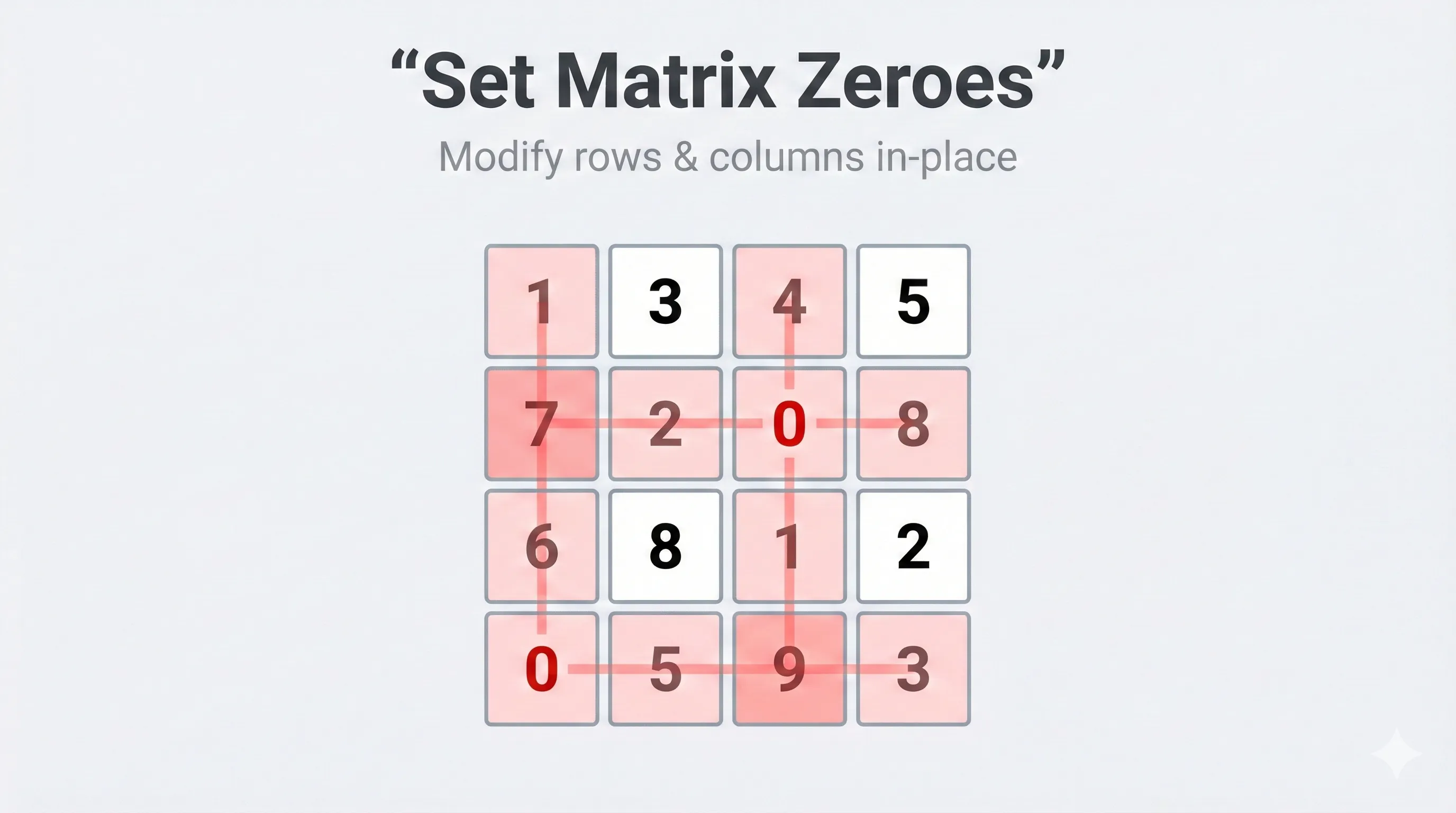
- We are given a matrix of size
m * n. - If any element in the matrix is
0, set its entire row and column to 0. - Constraint:
- The solution must use O(1) extra space.
LeetCode - Set Matrix Zeroes
Example#
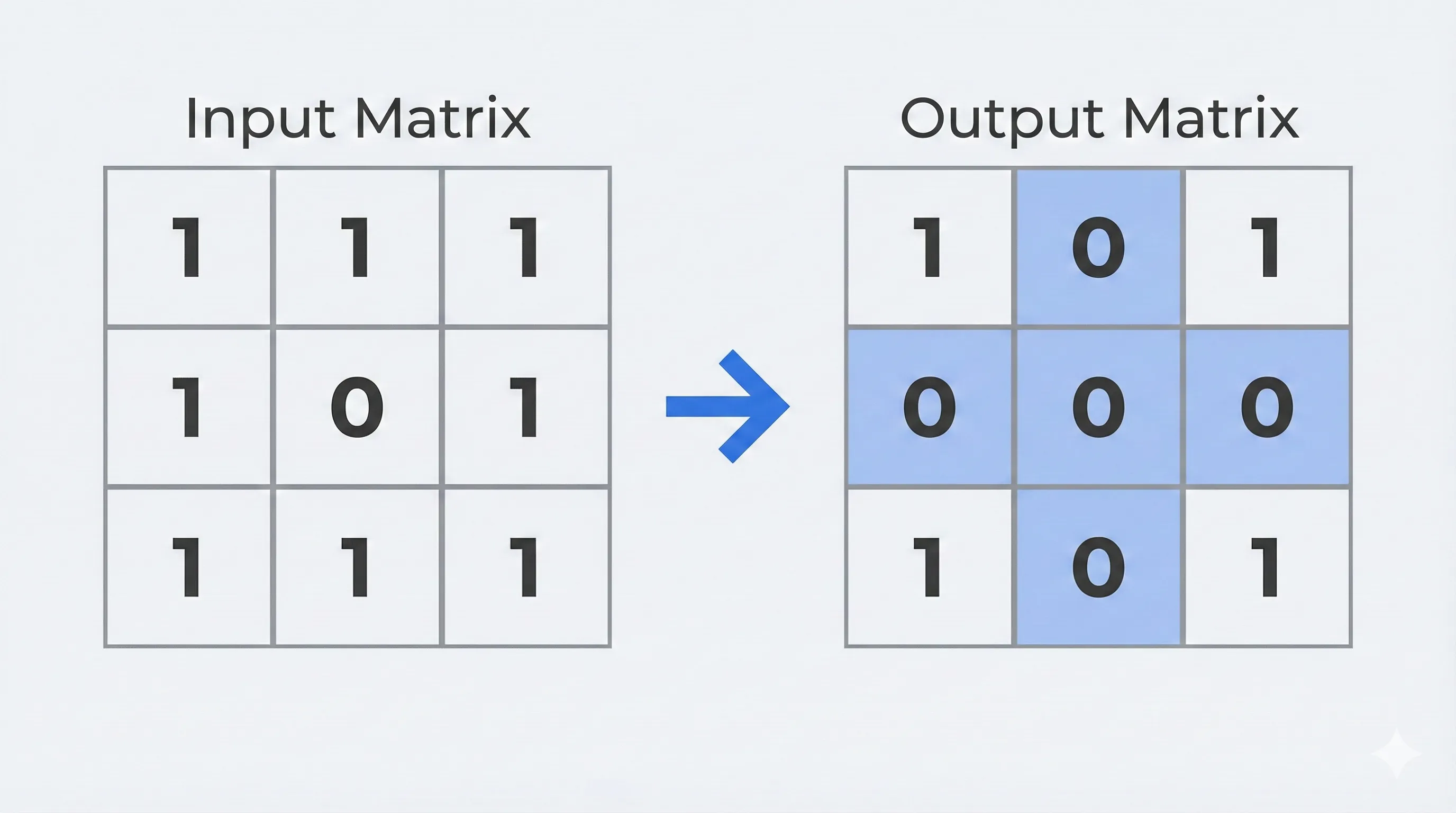
Input: matrix = [[1,1,1],[1,0,1],[1,1,1]]
Output: [[1,0,1],[0,0,0],[1,0,1]]
Brute Force#
Intuition and Approach#
 1
 2
 3
 4
 5
 6
 7
 8
 9
10
11
12
13
14
15
16
17
18
19
20
21
22
23
24
25
26
27
28
29
30
31
32
33
34
35
36
37
38
39
40
41
42
43
44
45
46
47
48
49
50
51
52
53
54
55
56
57
58
59
60
61
62
63
64
65
66
| class Solution {
public:
void setZeroes(vector<vector<int>>& matrix) {
int m = matrix.size();
int n = matrix[0].size();
bool firstRowZero = false;
bool firstColZero = false;
// Check first row
for (int j = 0; j < n; j++) {
if (matrix[0][j] == 0)
firstRowZero = true;
}
// Check first column
for (int i = 0; i < m; i++) {
if (matrix[i][0] == 0)
firstColZero = true;
}
// Mark rows and columns
for (int i = 1; i < m; i++) {
for (int j = 1; j < n; j++) {
if (matrix[i][j] == 0) {
matrix[0][j] = 0;
matrix[i][0] = 0;
}
}
}
// Set rows to zero
for (int i = 1; i < m; i++) {
if (matrix[i][0] == 0) {
for (int j = 1; j < n; j++) {
matrix[i][j] = 0;
}
}
}
// Set columns to zero
for (int j = 1; j < n; j++) {
if (matrix[0][j] == 0) {
for (int i = 1; i < m; i++) {
matrix[i][j] = 0;
}
}
}
// Handle first row if first row contains zero
if (firstRowZero) {
for (int j = 0; j < n; j++) {
matrix[0][j] = 0;
}
}
// Handle first column if first column contains zero
if (firstColZero) {
for (int i = 0; i < m; i++) {
matrix[i][0] = 0;
}
}
}
};
|
Why It Fails#
- Extra space used is proportional to the number of zeros.
- In the worst case, we store almost
m * n positions using O(m*n) space.
Time and Space Complexity#
- Time: O(m * n)
- Space: O(m * n)
In-Place Optimal Solution#
The trick is to use the first row and first column as markers instead of extra space.
Intuition and Approach#
Check if the first row contains zero.
Check if the first column contains zero.
Traverse the matrix from (1,1) to (m-1,n-1):
- If
matrix[i][j] == 0- Mark
matrix[0][j] = 0 - Mark
matrix[i][0] = 0
Traverse rows again:
- If first element of row is zero, set the entire row to zero.
Traverse columns again:
- If first element of column is zero, set the entire column to zero.
Finally, handle the first row and first column separately.
Edge Case#
- First row and first column are used as markers.
- If they originally contained zero, we must remember that using two boolean flags else we loose that data in the process.
Code Implementation#
 1
 2
 3
 4
 5
 6
 7
 8
 9
10
11
12
13
14
15
16
17
18
19
20
21
22
23
24
25
26
27
28
29
30
31
32
33
34
35
36
37
38
39
40
41
42
43
44
45
46
47
48
49
50
51
52
53
54
55
56
57
58
59
60
61
62
63
64
65
| class Solution {
public:
void setZeroes(vector<vector<int>>& matrix) {
int m = matrix.size();
int n = matrix[0].size();
bool firstRowZero = false;
bool firstColZero = false;
// Check first row
for (int j = 0; j < n; j++) {
if (matrix[0][j] == 0)
firstRowZero = true;
}
// Check first column
for (int i = 0; i < m; i++) {
if (matrix[i][0] == 0)
firstColZero = true;
}
// Mark rows and columns
for (int i = 1; i < m; i++) {
for (int j = 1; j < n; j++) {
if (matrix[i][j] == 0) {
matrix[0][j] = 0;
matrix[i][0] = 0;
}
}
}
// Set rows to zero
for (int i = 1; i < m; i++) {
if (matrix[i][0] == 0) {
for (int j = 1; j < n; j++) {
matrix[i][j] = 0;
}
}
}
// Set columns to zero
for (int j = 1; j < n; j++) {
if (matrix[0][j] == 0) {
for (int i = 1; i < m; i++) {
matrix[i][j] = 0;
}
}
}
// Handle first row if needed
if (firstRowZero) {
for (int j = 0; j < n; j++) {
matrix[0][j] = 0;
}
}
// Handle first column if needed
if (firstColZero) {
for (int i = 0; i < m; i++) {
matrix[i][0] = 0;
}
}
}
};
|
Time and Space Complexity#
- Time: O(m * n)
- Space: O(1)
Final Takeaways#
- The first row and first column can act as storage.
- Edge cases matter — especially when the storage area itself contains 0 data.