Problem Overview#
- We are given a string
s. - The string consists of all printable ASCII characters.
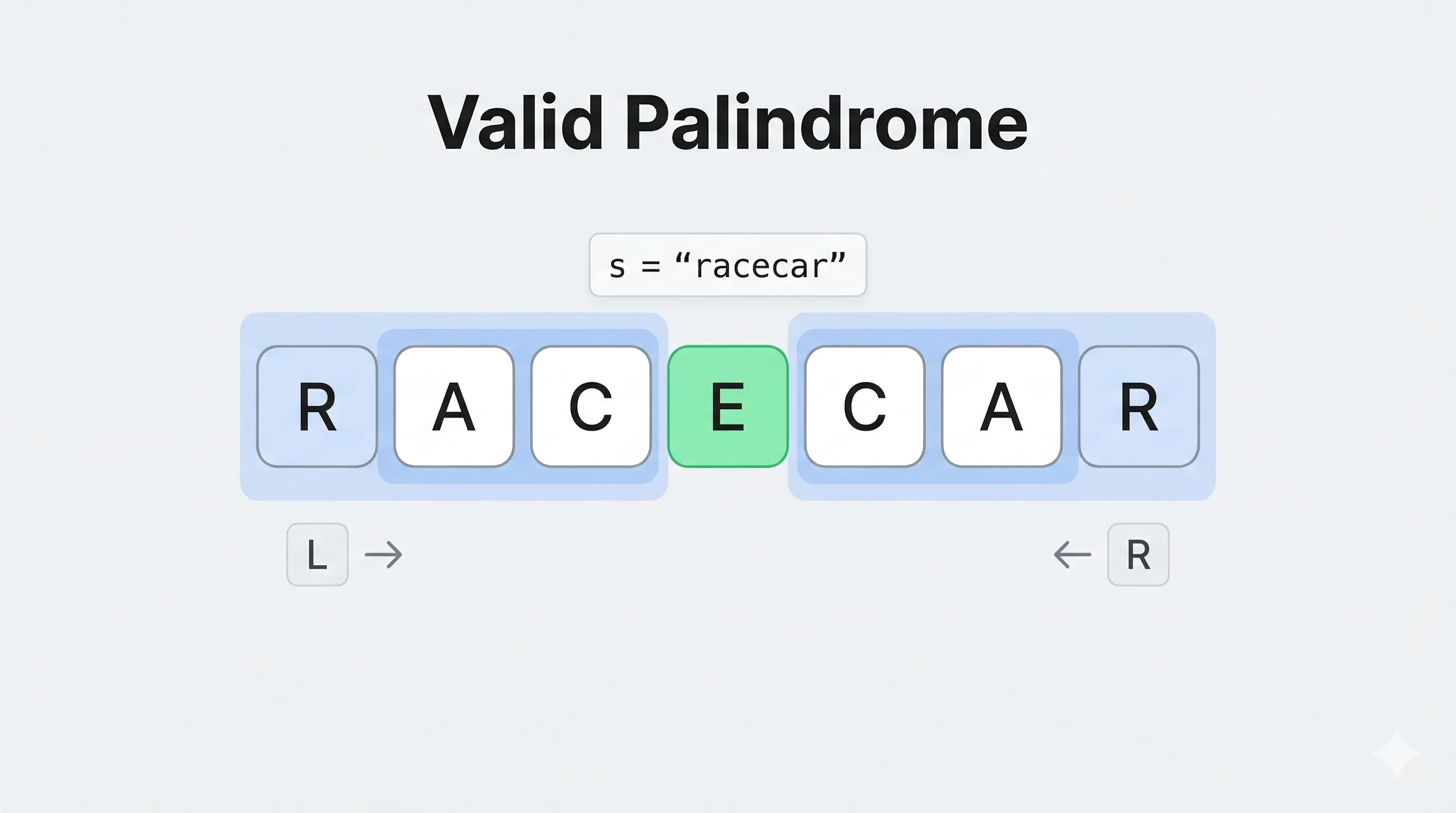
- Goal is to check if the string is a palindrome — but first we need to remove non-alphanumeric characters, then check.
A palindrome is a word or sentence if that reads the same backwards as forewords
LeetCode - Valid Palindrome
Example#
1
2
3
4
5
6
7
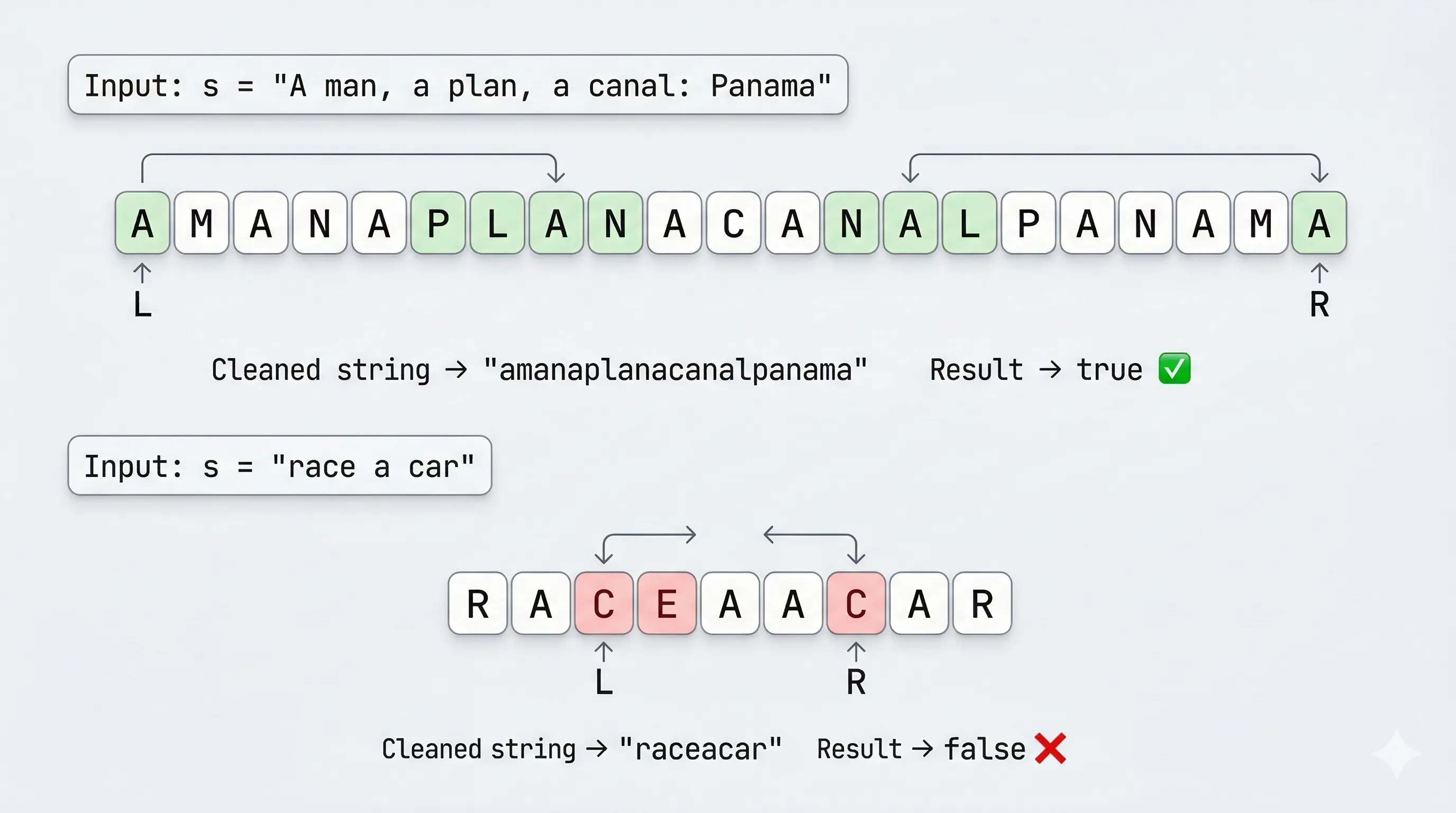
| Input: s = "A man, a plan, a canal: Panama"
Output: true
Explanation: "amanaplanacanalpanama" is a palindrome.
Input: s = "race a car"
Output: false
Explanation: "raceacar" is not a palindrome.
|
Brute Force#
Intuition#
- First, create a new string by removing all characters except
a-z, A-Z, and 0-9. - Convert characters to lowercase to ignore case differences.
- Then copy the output string and reverse it.
- Compare each character — if any character is different, the string is not a palindrome.
Code#
 1
 2
 3
 4
 5
 6
 7
 8
 9
10
11
12
13
14
15
16
17
18
19
20
21
22
23
24
25
26
| class Solution {
public:
bool isPalindrome(string s) {
string temp;
for (auto it : s) {
if ((it >= 'A' && it <= 'Z') ||
(it >= 'a' && it <= 'z') ||
(it >= '0' && it <= '9')) {
temp += tolower(it);
}
}
string rev = temp;
reverse(rev.begin(), rev.end());
int n = rev.size();
for (int i = 0; i < n; i++) {
if (rev[i] != temp[i])
return false;
}
return true;
}
};
|
Time and Space Complexity#
- Time → O(n)
- Space → O(n) — extra
temp and rev strings of size n
Optimization#
Intuition#
- On observation, if the string is a palindrome, both halves must mirror of each other.
- Instead of using another string and reversing it, we can use a two pointer approach.
- Left pointer starts from
0 and right pointer from n-1. - If characters at left and right are the same, move both inward.
Code#
 1
 2
 3
 4
 5
 6
 7
 8
 9
10
11
12
13
14
15
16
17
18
19
20
21
22
23
24
25
26
| class Solution {
public:
bool isPalindrome(string s) {
string clean;
for (auto it : s) {
if ((it >= 'A' && it <= 'Z') ||
(it >= 'a' && it <= 'z') ||
(it >= '0' && it <= '9')) {
clean += tolower(it);
}
}
int n = clean.size();
int l = 0, r = n - 1;
while (l <= r) {
if (clean[l] != clean[r]) return false;
l++;
r--;
}
return true;
}
};
|
Time and Space Complexity#
- Time → O(n)
- Space → O(n) — still using the
clean string of size n
Further Optimization#
Intuition#
- Instead of creating a new string, we can directly operate on the original string
s. - Use two pointers starting from
0 and n-1. - Skip characters that are not alphanumeric.
- Once both pointers point to valid characters, compare them.
- If they match, move both pointers inward.
Code#
 1
 2
 3
 4
 5
 6
 7
 8
 9
10
11
12
13
14
15
16
17
18
19
20
21
| class Solution {
public:
bool isPalindrome(string s) {
int l = 0, r = s.size() - 1;
while (l < r) {
while (l < r && !isalnum(s[l])) l++;
while (l < r && !isalnum(s[r])) r--;
if (tolower(s[l]) != tolower(s[r]))
return false;
l++;
r--;
}
return true;
}
};
|
Time and Space Complexity#
Key Takeaways#
- Small observations can lead to big optimizations.
- Small improvements can make the algorithm more efficient.