Problem Overview
- We are given a 2D array of characters named
board. - The board size is
m x n. - We are also given a string
word. - Our goal is to find whether the word exists in the board.
- If found → return
true, otherwise → returnfalse.
Example
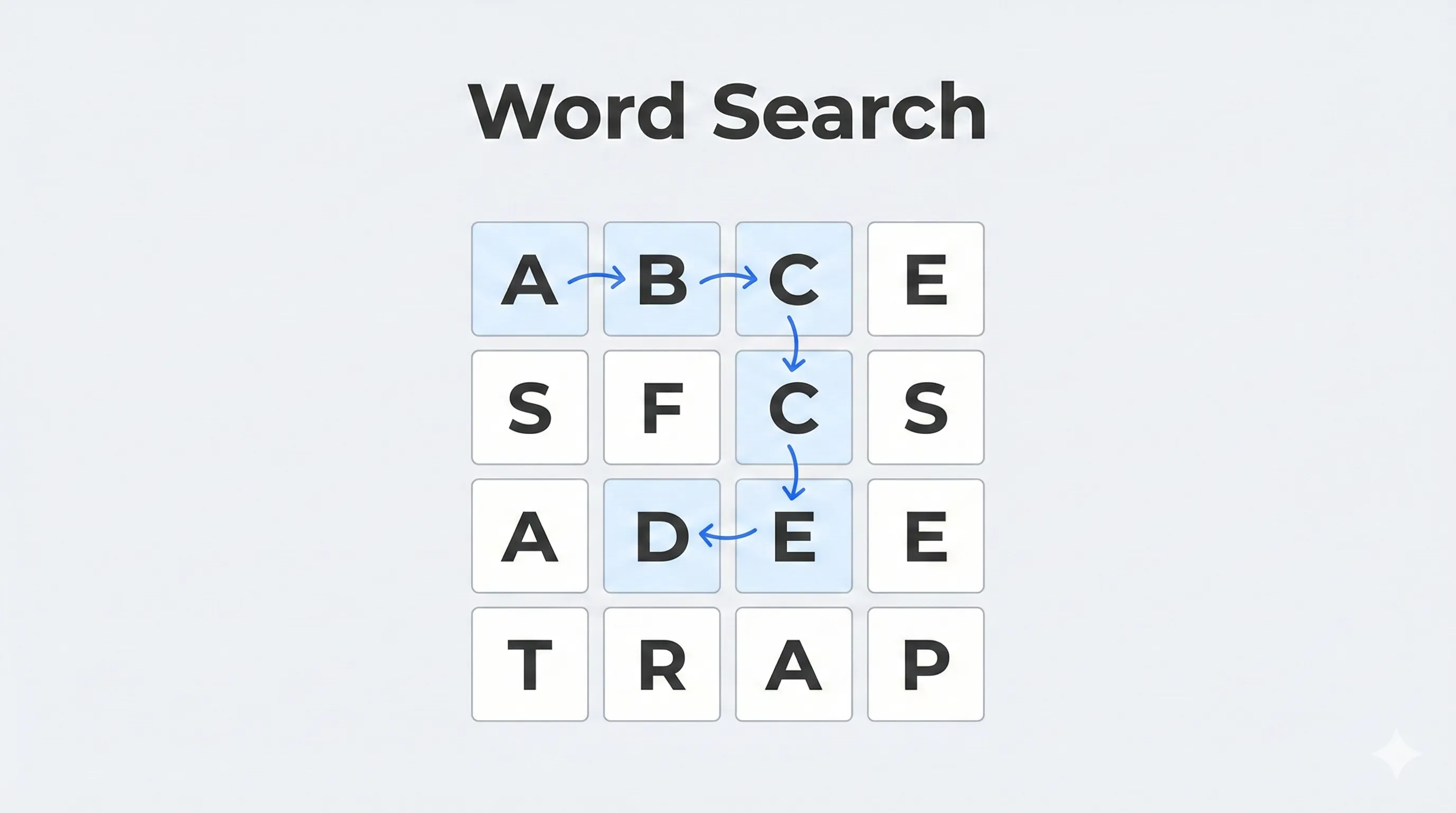
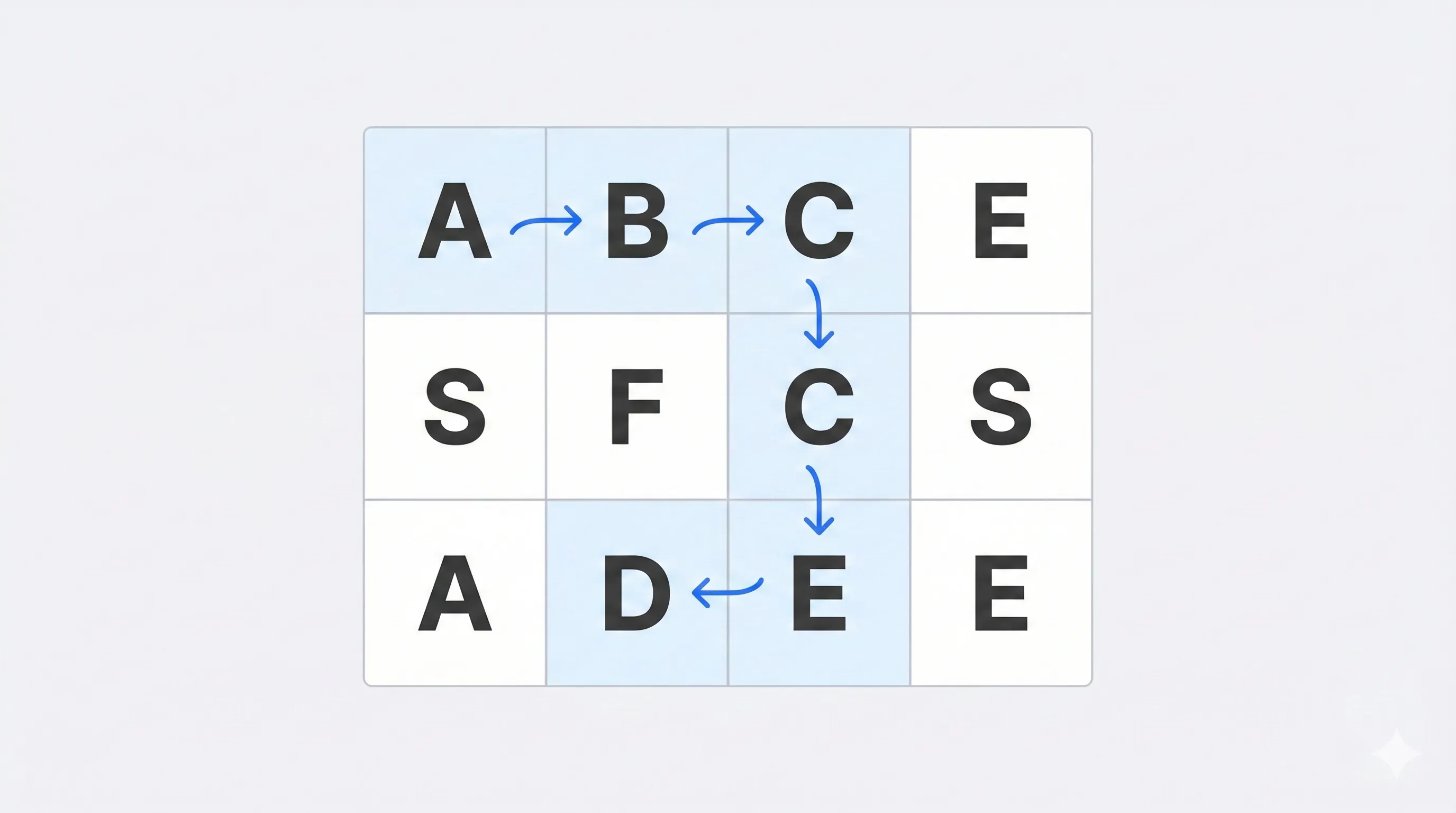
Input: board = [["A","B","C","E"],
                ["S","F","C","S"],
                ["A","D","E","E"]],
       word = "ABCCED"

Output: true
Intuition
First, we need to find
word[0]in the matrix.If we find it, we start searching in four directions using recurrsion
- Top
- Bottom
- Left
- Right
From there, we search for the next character.
If it matches, we continue recursively.
If we reach the last character → return
true.
This problem is combination DFS and Backtracking .
Approach
Base Solution — DFS + Backtracking
class Solution {
public:
    bool exist(vector<vector<char>>& board, string word) {

        int m = board.size();
        int n = board[0].size();

        for (int i = 0; i < m; i++) {
            for (int j = 0; j < n; j++) {
                if (search(i, j, board, word, 0))
                    return true;
            }
        }

        return false;
    }

    bool search(int i, int j, vector<vector<char>>& board,
                string& word, int index) {

        int m = board.size();
        int n = board[0].size();

        // Boundary check
        if (i < 0 || i >= m || j < 0 || j >= n)
            return false;

        // Character mismatch
        if (board[i][j] != word[index])
            return false;

        // If last character matched
        if (index == word.size() - 1)
            return true;

        char temp = board[i][j];
        board[i][j] = '#';   // mark visited

        bool found =
            search(i+1, j, board, word, index+1) ||
            search(i-1, j, board, word, index+1) ||
            search(i, j+1, board, word, index+1) ||
            search(i, j-1, board, word, index+1);

        board[i][j] = temp;  // restore (backtrack)

        return found;
    }
};
Optimized Version
What We Improve
Frequency Pruning
- If the board does not contain required characters → return
falseearly. - This avoids unnecessary recursion.
- If the board does not contain required characters → return
Start from the Rarer Character
- If the last character appears less frequently than the first character,
- Reverse the word.
- This reduces branching and recursion calls.
Optimized Code
class Solution {
public:
    bool exist(vector<vector<char>>& board, string word) {

        int m = board.size();
        int n = board[0].size();

        // Step 1: Frequency pruning
        vector<int> boardFreq(128, 0);
        for (int i = 0; i < m; i++) {
            for (int j = 0; j < n; j++) {
                boardFreq[board[i][j]]++;
            }
        }

        for (char c : word) {
            if (--boardFreq[c] < 0)
                return false;
        }

        // Step 2: Start from rarer character
        int firstCount = 0, lastCount = 0;
        for (int i = 0; i < m; i++) {
            for (int j = 0; j < n; j++) {
                if (board[i][j] == word[0]) firstCount++;
                if (board[i][j] == word[word.size()-1]) lastCount++;
            }
        }

        if (lastCount < firstCount) {
            reverse(word.begin(), word.end());
        }

        // Normal DFS
        for (int i = 0; i < m; i++) {
            for (int j = 0; j < n; j++) {
                if (dfs(i, j, board, word, 0))
                    return true;
            }
        }

        return false;
    }

    bool dfs(int i, int j, vector<vector<char>>& board,
             string& word, int index) {

        if (index == word.size())
            return true;

        int m = board.size();
        int n = board[0].size();

        if (i < 0 || i >= m || j < 0 || j >= n ||
            board[i][j] != word[index])
            return false;

        char temp = board[i][j];
        board[i][j] = '#';

        bool found =
            dfs(i+1, j, board, word, index+1) ||
            dfs(i-1, j, board, word, index+1) ||
            dfs(i, j+1, board, word, index+1) ||
            dfs(i, j-1, board, word, index+1);

        board[i][j] = temp;

        return found;
    }
};
Time and Space Complexity
- Time: O(m × n × 4^L)
Where:
m × n→ possible starting pointsL→ length of word4^L→ exploring 4 directions recursively
With pruning, average performance improves significantly.
- Space: O(L)
- Due to recursion stack
- No extra data structures used apart from frequency array
Final Takeaways
Always break the problem into smaller subproblems.
In recursion, always handle exit/base conditions carefully.
Backtracking means:
- Mark
- Explore
- Restore
Try to reduce unnecessary recursive calls using pruning.
Grid + word search problems → Think DFS + Backtracking first.