Introduction
In modern systems, messaging queues are one of the most essential building blocks.
They are the unsung heroes that help us decouple services, making our systems scalable, fault-tolerant, and efficient.
Without queues, managing communication between multiple services would be chaotic and unreliable.
Why Queues?
The Monolithic Scenario
In a monolithic architecture, all parts of the system are tightly coupled.
Let’s take an example of three services connected directly: A → B → C.
If component B is busy or unavailable, then A must wait — blocking the process flow.
Similarly, if B takes a long time to complete a task, A waits while C remains idle.
This tight coupling leads to inefficiency, poor scalability, and system fragility.
The Queue-Based Approach
Key Concepts
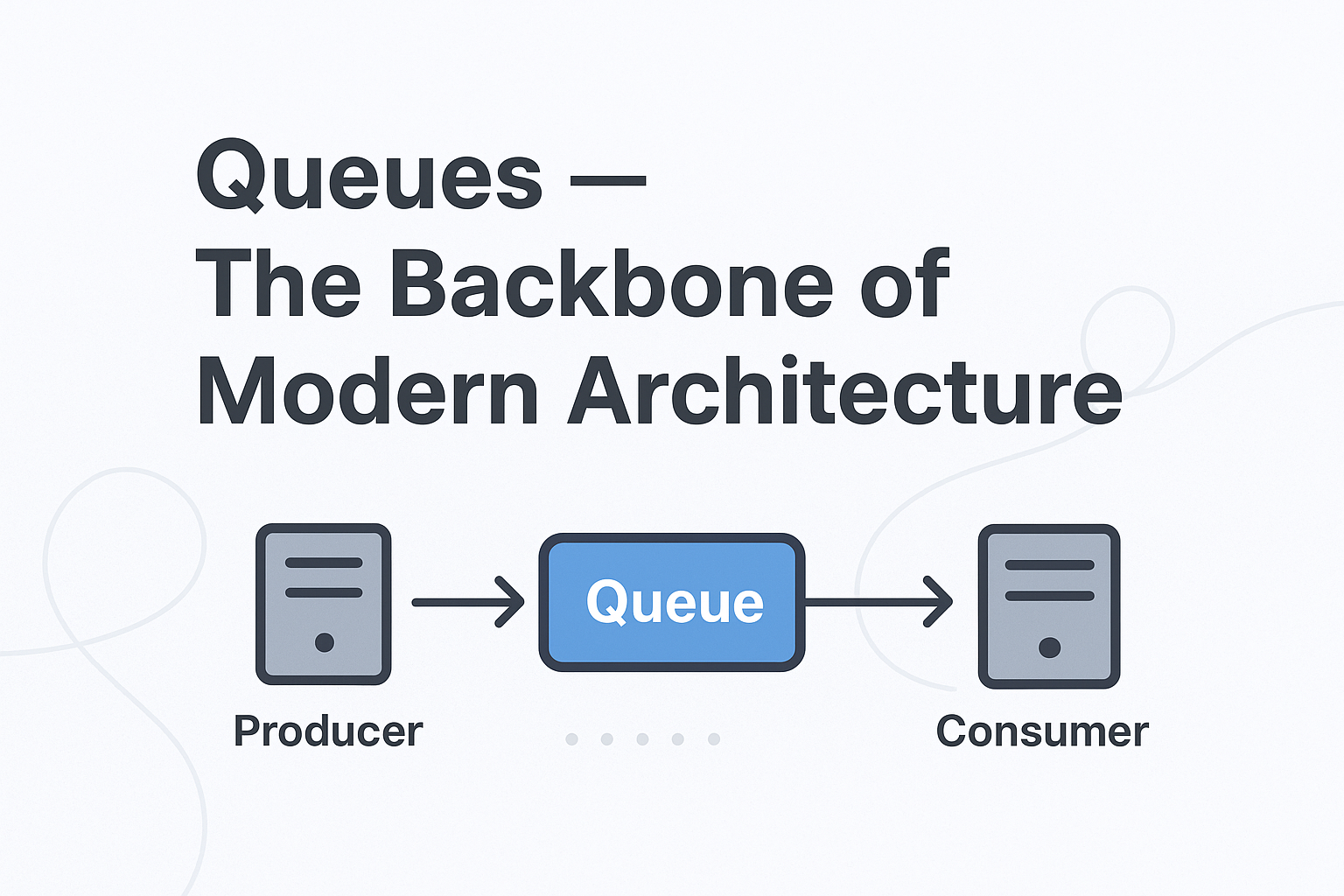
Before we proceed, let’s define the key components of a queue-based system:
- Producer: The service that creates a task or message.
- Queue: Temporarily holds the messages until they’re processed.
- Consumer: Retrieves and processes messages from the queue.
Decoupling Through Queues
By introducing a messaging queue, components no longer depend directly on one another.
- A (Producer) performs its job and pushes a message to the queue.
- B (Consumer) picks up messages whenever available, processes them, and optionally pushes results to another queue for C.
Each service now works independently and asynchronously, improving overall system performance and reliability.
And that’s not all — queues bring several additional advantages.
Benefits of Using Queues
1. Decoupling
Producers and consumers operate independently. They don’t need to know or care about each other’s implementation details.
2. Scalability
If B can’t keep up with A, multiple instances of B can be added to process tasks in parallel — no major code changes required.
3. Fault Tolerance
If a consumer (say C) goes down, its pending tasks remain safely in the queue.
Once C recovers, it resumes processing. Queues can even retry tasks automatically before marking them as failed.
4. Load Management
Queues naturally help distribute load — services can scale up or down based on demand.
This ensures smooth operation even during traffic spikes.
Real-World Examples
Sending a Welcome Email
When a user registers:
- The registration service adds a “send welcome email” task to the queue.
- The email service later picks it up and sends the email.
This keeps registration fast while ensuring the email is sent reliably.
Payment Processing
When using a payment gateway, even if you close or refresh the page, the payment status is still updated.
That’s because the update request was added to a queue — ensuring it’s processed reliably in the background.
Conclusion
Messaging queues are the unsung heroes of modern microservice architectures.
They make systems more resilient, maintainable, and scalable.
From sending emails to processing millions of payment requests — queues silently keep modern systems running smoothly behind the scenes.